
What is PIR insulation – a complete guide
This guide aims to clearly and practically explain what PIR insulation is, its technical characteristics, and where it can be used to improve a building’s thermal performance. We will look at its thermal efficiency, advantages and limitations, as well as how it can be properly integrated into different construction systems.
The information is useful for architects and designers, as well as for builders, installers, and end users looking for an efficient thermal insulation solution. In practice, the correct choice of insulation has a direct impact on thermal comfort, energy consumption, and long-term operating costs of a building, regardless of season.
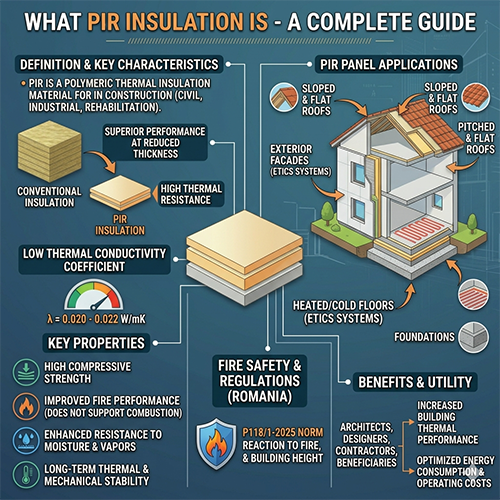
- PIR insulation is a polymer-based thermal insulation material used in civil and industrial construction, as well as in thermal renovation projects.
- PIR boards provide high thermal resistance, enabling superior performance compared to many conventional insulation materials, while using reduced thicknesses.
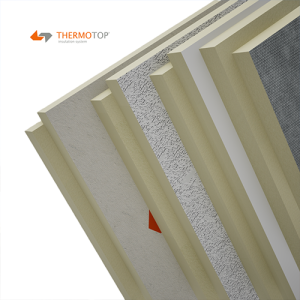
- PIR insulation boards are rigid panels available with different facings, designed for applications in roofs, façades, floors, and other elements of the building envelope.
PIR insulation is derived from the polyurethane foam family, being an improved version of PUR foam. The material is available as rigid boards that are easy to handle and install on site. PIR boards are manufactured in standard dimensions such as 1200 × 600 mm, 1200 × 1200 mm, or 2400 × 1200 mm, but also in custom sizes depending on project requirements.
One of the main advantages of PIR is its very low thermal conductivity coefficient, ranging between 0.020–0.022 W/mK. In practical terms, this means high thermal resistance can be achieved with thinner insulation layers compared to other solutions.
Due to its closed-cell structure, PIR offers excellent thermal insulation performance at reduced thickness, high compressive strength, increased resistance to moisture and temperature variations, and long-term stability of both thermal and mechanical properties. It also has improved fire performance (it does not support combustion) and good resistance to water vapour and moisture.
Thanks to these characteristics, PIR boards are used in a wide range of applications: foundations, pitched roofs, flat roofs, external façades, as well as cold or heated floors. In ETICS systems, they can be used in compliance with the fire safety regulations applicable in each country and building type. In Romania, the P118/1-2025 standard sets specific requirements regarding the reaction to fire of materials and the use of thermal insulation in façade systems, depending on building height regime and the chosen construction solution.
What are the thermal performance characteristics of PIR boards?
As with any thermal insulation material, the thermal performance of PIR boards can be expressed through two key indicators commonly used in design and construction:
-
Thermal conductivity (λ – lambda) represents the intrinsic property of a material to conduct heat. It is independent of thickness and describes the efficiency of the material itself. In the case of PIR boards, λ values are generally very low (around 0.020–0.022 W/mK), which places them in the category of high-performance thermal insulation materials.
-
Thermal resistance (R-value) expresses the ability of a material layer to resist heat transfer and depends directly on its thickness. The greater the thickness and the lower the λ value, the higher the thermal resistance.
In practice, thermal resistance is calculated simply by dividing the thickness of the layer (expressed in meters) by the declared thermal conductivity:
$$R = \frac{d}{\lambda}$$
For example, for a PIR board with a thickness of 100 mm (0.10 m) and a thermal conductivity coefficient λ = 0.021 W/mK, the resulting thermal resistance is approximately:
$$R = \frac{0.10}{0.021} \approx 4.76 \text{ m}^2\text{K/W}$$
These values are essential in building envelope design. Based on thermal conductivity, the thermal resistance of the insulation layer is determined, and subsequently the thermal transmittance (U-value) of the construction element. Using these calculations, the required insulation thickness is established in order to meet energy efficiency requirements, including nZEB standards, and to reduce long-term energy consumption.
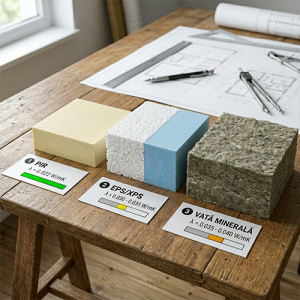
Comparison of thermal conductivity coefficient (λ)
To better understand the positioning of PIR insulation compared to other thermal insulation materials, it is useful to compare the thermal conductivity coefficient (λ), which indicates a material’s ability to conduct heat.
| Insulation Type | Thermal Conductivity λ (W/mK) |
Notes |
|---|---|---|
| PIR | 0,020 – 0,022 | Very high performance at reduced thickness |
| EPS – XPS | 0,030 – 0,040 | Cost-effective solution, commonly used in façades |
| Mineral Wool | 0,035 – 0,045 | Requires greater thickness to achieve the same performance (e.g., ~160–180 mm mineral wool ≈ ~100 mm PIR) |
Advantages and disadvantages of PIR insulation
PIR boards are considered an efficient and versatile thermal insulation solution, used in a wide range of construction applications. Their technical characteristics make it easy to integrate into different building systems; however, like any material, they require correct selection and proper installation.
| Characteristics | Advantages | Disadvantages |
|---|---|---|
| Wide application in construction | Versatile solution, widely used in residential and industrial applications, from foundations to roofing | Correct identification of the board type can be challenging → technical documentation and manufacturer consultation are recommended |
| Thermal efficiency | Enables high performance without significantly increasing insulation thickness | Performance can be affected by installation → careful workmanship and proper joint sealing are required |
| Board dimensions | Large dimensions allow fast installation and reduce the number of joints | More difficult handling in narrow areas → can be optimized by selecting the appropriate size for each application |
| Mechanical behavior | High compressive strength allows use in floors, walkable terraces, and industrial roofing systems | Requires compliance with specific design requirements |
| Types of facings | Allows adaptation to different construction systems (membranes, cladding, adhesives) | Cost and compatibility may vary → facing must be selected according to the construction system and layer composition |
| Fire behavior | Can be integrated into compliant systems depending on the construction solution | Requires strict compliance with design and execution requirements |
In practice, PIR boards are valued for their efficiency in applications where thermal performance must be optimized without significantly increasing insulation thickness. The correct selection of the board type and its integration into an appropriate construction system are essential to achieving the desired performance.
What is the lifespan of PIR insulation?
The service life of PIR boards is typically comparable to the lifespan of the building itself, provided they are correctly specified, installed, and protected within the building envelope.
To better understand long-term performance, it is useful to analyze the main technical characteristics that influence material durability:
| Characteristic | Advantage |
|---|---|
| Thermal conductivity | λ = 0,022 W/mK |
| Thermal performance | Up to 100% more efficient insulation compared to traditional materials |
| Mechanical strength | High compressive strength |
| Dimensional stability | Does not shrink, expand, or lose thermal properties over time |
| Moisture resistance | Does not allow moisture penetration |
| Pest resistance | Does not provide food or habitat for rodents |
| Applications | Suitable for both new construction and renovation works |
| Chemical behavior | Inert, safe material |
| Weight | Lightweight, easy to handle and install |
| Board joints | “L” edge joints reduce thermal bridges |
| Efficiency at low thickness | High thermal resistance at reduced thickness |
| Weather resistance | Stable performance in extreme weather conditions |
| System compatibility | Compatible with all types of waterproofing membranes |
| Finish compatibility | Compatible with all types of renders and external finishes |
| Fire behavior | Does not contribute to fire spread – ETICS class B-s1, d0 |
| Chemical resistance | Resistant to petroleum-based substances and solvents |
| Resistant to mold and fungal growth | Does not support mold, fungi, or microorganism growth |
| Sustainability | Contributes to reduced energy consumption |
| Ecofriendly | Environmentally friendly material |
Where is PIR insulation used?
Thanks to its various thicknesses, dimensions, and facing types, PIR insulation is a high-performance solution that can be easily integrated into a wide range of applications.
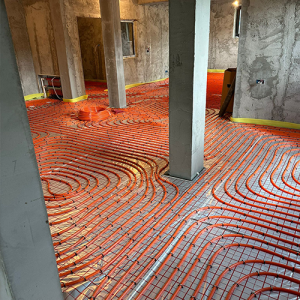
Floors
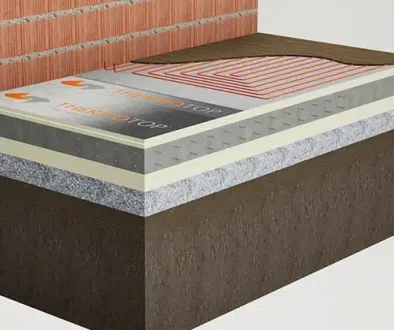
One of the most common applications of PIR insulation is in floor insulation, both for cold and heated floors.
IR boards can be used in:
- water-based underfloor heating systems
- electric underfloor heating systems
- unheated (cold) floors
Depending on the construction solution, PIR boards can be installed above or below the concrete slab, contributing to the overall thermal performance of the floor system.
In all these cases, PIR insulation provides:
- high thermal performance at reduced thickness
- reduced energy losses toward the substrate
- optimized energy consumption for heating and cooling
- compatibility with various underfloor heating systems
- reduced total insulation thickness
- maximized usable interior space
In underfloor heating systems, PIR insulation helps direct heat flow efficiently into the room, reducing downward heat losses.
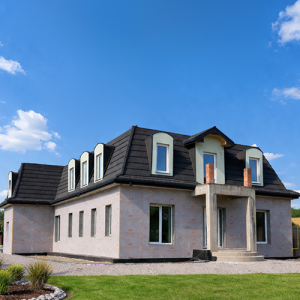 External walls: ETICS façades and ventilated façades
The use of PIR insulation in façade systems—whether ETICS with decorative render or ventilated façades—significantly improves the building envelope’s performance.
By integrating PIR boards into ETICS systems, the following is achieved:
- reduction of thermal bridges
- improved airtightness
- increased overall thermal performance of the building
- optimized construction costs
Key advantages of PIR in façade systems:
- improved thermal performance of the building envelope
- minimized thermal bridges
- protection against rodents
- resistance to moisture and mold
- compatibility with external renders and finishes
- potential to achieve fire reaction class B-s1,d0 in ETICS systems with decorative render
- controlled vapor permeability in properly designed façade systems
Operational benefits:
- reduced heating and cooling costs by up to 30%
- optimized overall construction costs
- reduced thickness of auxiliary elements (fixings, profiles, window reveals, etc.)
- increased building lifespan
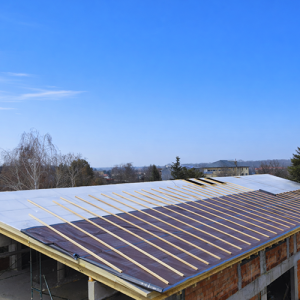
Pitched roofs
In pitched roof systems, PIR boards can be installed between rafters, above rafters, below rafters, or in combined solutions. This flexibility allows adaptation to different roof configurations and makes PIR suitable for both new construction and attic conversions.
Advantages of PIR insulation in pitched roofs:
- reduced risk of condensation due to better layer control
- lightweight material that does not overload the structure
- adaptability to complex details (ridges, valleys, penetrations)
- easy cutting and installation for precise integration
- possibility of combining with other insulation layers
Operational benefits:
- more efficient use of interior space without significant loss of height
- year-round thermal comfort (winter and summer)
- improved durability of roof structure by protecting timber elements
- flexibility in renovation and modernization without major structural changes
- optimized solutions for habitable attic spaces
Overall, PIR insulation provides a compact, efficient, and adaptable solution for complex roof geometries.
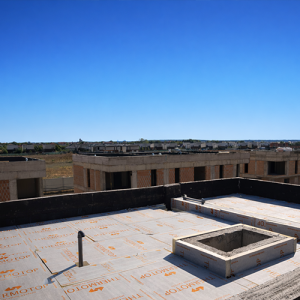
Flat roofs and terraces
For walkable, non-walkable, or green terraces, PIR boards are compatible with all types of bituminous or synthetic membranes and can be integrated into various construction solutions.
Advantages:
- compatibility with multiple waterproofing systems
- high dimensional stability (no expansion, contraction, or thermal degradation over time)
- lightweight, easy and fast installation
- good compressive strength suitable for walkable terraces or technical roofs
- continuous insulation layer can be achieved
- adaptability to different terrace types (walkable or non-walkable)
Operational benefits:
- reduced energy losses through large roof surfaces
- optimized structure due to lower permanent loads
- increased durability of roofing system
- stable behavior under service loads
- efficient execution on large surfaces
PIR boards provide an efficient thermal insulation system optimized for large-area roofing applications.
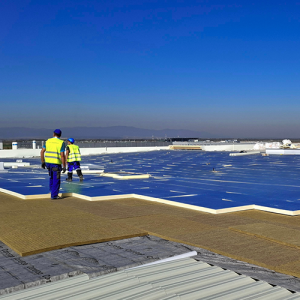
Industrial applications: Thermotop Roof System
In industrial and civil buildings with large spans between supports, the roof represents one of the main design and execution challenges. Large-area constructions require roofing systems that simultaneously ensure thermal performance, load-bearing capacity, and fire safety, without using excessively thick structural elements that increase overall costs.
For such applications, Thermotop has developed two roofing systems with certified fire resistance of 20 and 30 minutes.
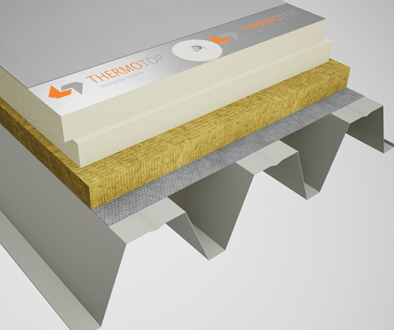
Thermotop Roof System REI 20
- self-supporting corrugated steel sheet h150 mm, 0.88 mm thickness (structural and load-bearing element)
- vapor barrier (vapor diffusion control)
- PIR thermal insulation board – Thermotop AL, 100 mm, with aluminum foil (main thermal insulation layer)PVC waterproofing membrane – 1.5 mm
Thermotop Roof System REI 30
- self-supporting corrugated steel sheet h150 mm, 0.88 mm thickness
- vapor barrier
- mineral wool layer, density 70 kPa, 50 mm thickness, thermal conductivity 0.040 W/mK
- PIR thermal insulation board – Thermotop AL, 100 mm, with aluminum foil
- PVC waterproofing membrane – 1.5 mm
The main difference between the two systems is the additional mineral wool layer in the REI 30 configuration, which increases fire resistance.
These systems reduce the structural weight of the roof and allow integration of ventilation systems, photovoltaic panels, or other installations that would normally create structural challenges.
Mechanical performance and structural behavior
The Thermotop Roof System is designed to meet the specific requirements of industrial roofing:
- high load-bearing capacity due to self-supporting corrugated steel sheet
- compressive strength of insulation suitable for distributed loads (equipment, occasional traffic, PV panels)
- reduced system weight, lowering permanent and variable loads and optimizing structural design
- possibility of large spans between supports without increasing overall costs
These characteristics enable more economical structural designs with reduced material consumption.
Thermal performance and energy efficiency
The PIR insulation layer, with low thermal conductivity (λ ≈ 0.021 W/mK), enables low roof U-values even at optimized thicknesses.
In industrial buildings, where roof surfaces are dominant, this results in:
- reduced energy losses over large areas
- lower heating and cooling demand
- improved indoor temperature stability, important for technological processes or storage
Operational benefits
- long-term reduction in energy costs
- optimized structural and construction costs
- durability and stable long-term performance
- compliance with fire safety requirements
- flexibility for different industrial project types
Conclusion
This system enables the design of industrial roofs that are energy-efficient, fire-safe, and structurally optimized.